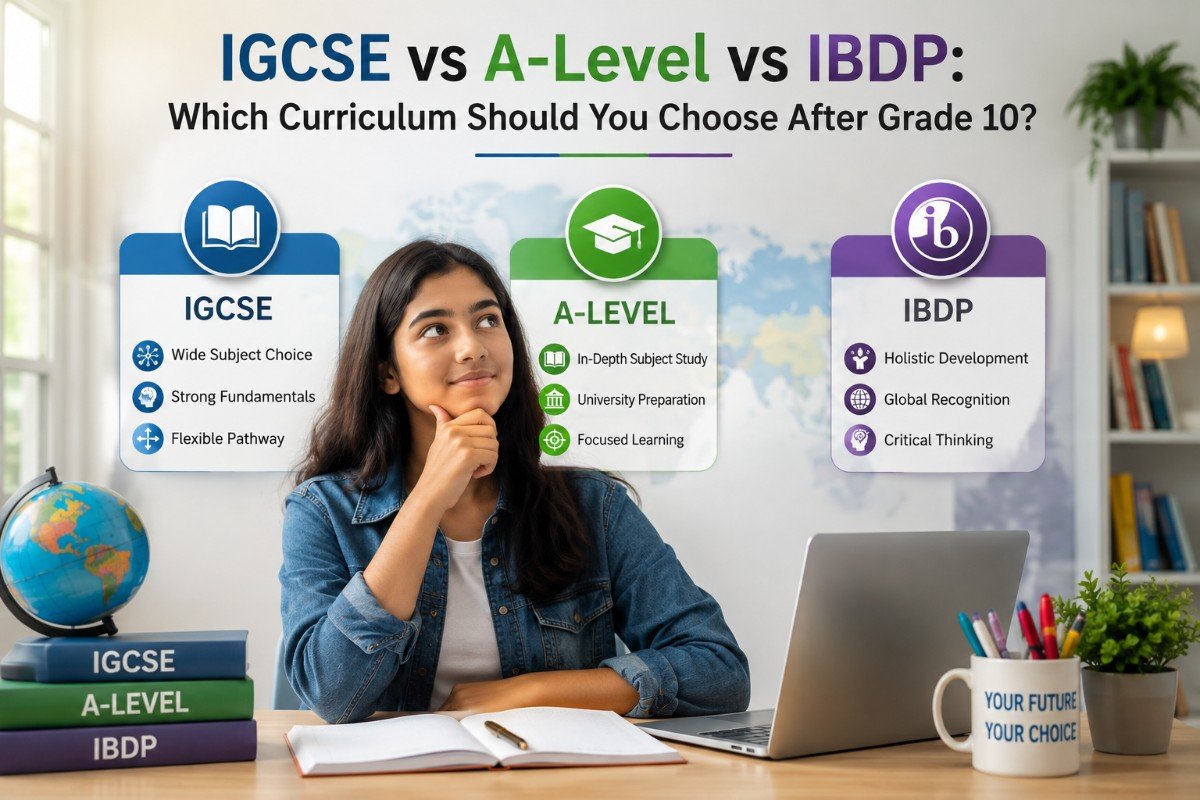
Grade 10 is the point where a lot of families realize the next choice matters more than any before it — A-Level or IBDP shapes workload, university options, and even how your child studies for the next two years. Here's a genuinely detailed, side-by-side look, not just a surface comparison.
Wisdom Academy • International Board Coaching
IGCSE, A-Level, or IBDP?
By the time a student finishes Grade 10 — whether through IGCSE, ICSE, or CBSE — most parents assume the hard academic decisions are behind them. In reality, the next one is often the most consequential: whether to pursue A-Level or the IB Diploma Programme (IBDP) for the final two years before university. Get this right, and a student spends two years working to their strengths. Get it wrong, and even a capable student can spend two years fighting a system that doesn't suit how they think or work.
This isn't a "which is better" question — despite how it's usually framed online. A-Level and IBDP are both rigorous, both globally respected, and both lead to strong university outcomes. The real question is which one fits a specific student's academic profile, career direction, and working style. That's what this article actually helps you work out.
First, What Each Qualification Actually Is
IGCSE (typically Grades 9–10, ages 14–16) is a broad, foundational qualification from Cambridge Assessment International Education, covering a wide spread of subjects — sciences, humanities, languages, and electives — designed to build strong fundamentals before specialization begins. It isn't really an alternative to A-Level or IBDP; it's the stage that precedes both.
A-Level (typically Grades 11–12, ages 16–18) is a UK-origin qualification where students specialize early, usually choosing just 3–4 subjects to study in depth over two years — AS Level in the first year, full A-Level in the second. It's assessed almost entirely through final written exams per subject, set by Cambridge International, Edexcel, or OCR depending on the school.
IBDP (also Grades 11–12) takes the opposite structural approach: students study six subjects across different disciplines simultaneously — three at Higher Level, three at Standard Level — alongside three additional core components: Theory of Knowledge (TOK), the Extended Essay (EE), and Creativity, Activity, Service (CAS). It deliberately resists early specialization in favor of breadth.
Side-by-Side: A-Level vs IBDP
| Factor | A-Level | IBDP |
|---|---|---|
| Structure | 3–4 subjects, chosen based on intended university course | 6 subjects across all major disciplines, plus TOK, EE, CAS |
| Specialization | Early and deep — ideal if the career direction is already clear | Delayed — keeps humanities, sciences, and languages all active |
| Assessment style | Mostly final written exams; some coursework depending on subject | Mix of exams, internal assessments, oral components, and extended written work (EE) |
| Workload pattern | Concentrated — intense depth in fewer subjects | Distributed — steady, simultaneous demands across many components year-round |
| Grading scale | A*–E per subject | 1–7 points per subject (42 max) + up to 3 bonus points from TOK/EE (45 total) |
| University recognition | Very strong in the UK (native qualification); well recognized globally | Very strong globally, particularly favored by US, Canadian & European universities for its breadth and EE research experience |
| Best suited to | Students with a clear subject preference or career direction already forming | Students who enjoy variety, strong time-managers, and those still exploring direction |
Why This Decision Is Really About Working Style, Not Intelligence
The most common misconception about this choice is that it's about academic ability — "IBDP is for the smartest kids" is a myth worth retiring early. Both programmes are demanding for genuinely different reasons, and student success in each correlates far more strongly with working style than raw ability.
A-Level rewards students who focus well in fewer areas and prefer going deep rather than juggling many things at once. The workload is intense but concentrated — a student isn't managing six different types of assignments in the same week. IBDP rewards students who are comfortable with sustained, distributed effort across many fronts simultaneously — a CAS activity, an EE draft, a TOK essay, and exam prep for six subjects, often all in the same month. Neither working style is superior; they're just different, and a student who thrives under one can genuinely struggle under the other, independent of how capable they are.
Matching the Curriculum to the Student
Lean A-Level. If a student already knows they want engineering, medicine, or economics, specializing early in Maths, Physics, Chemistry (or Economics, Business, Maths) lets them build depth exactly where universities will look for it, without spending time on subjects they've already ruled out.
Lean IBDP. Keeping six subjects across disciplines active for two more years genuinely delays the specialization decision without academic penalty — useful for a student who might want to keep both a science and a humanities pathway open into university applications.
IBDP often has an edge. US and Canadian admissions officers are broadly familiar with the IB's holistic structure, and the Extended Essay gives applicants a genuine independent-research credential that stands out in liberal-arts-style applications.
Either works well, but A-Level is the default. As the UK's native qualification, A-Level results map directly onto UCAS offers without any conversion, which some families find simpler to plan around.
Lean A-Level. Choosing only 3–4 subjects means a student can play to genuine strengths rather than needing at least reasonable competence across six simultaneous subjects, including ones they may not enjoy.
IBDP formally recognizes this through CAS — a required component, not an extracurricular add-on — which can suit a student already committed to activities outside the classroom, since it's built into the qualification rather than competing with study time unofficially.
What Doesn't Actually Matter As Much As Parents Think
Two concerns come up constantly in these conversations, and both deserve a more measured answer than they usually get.
"Will one hurt university admissions chances compared to the other?"
For the vast majority of universities worldwide, no — both are well understood and well regarded by admissions offices, including in India, the UK, US, Canada, Singapore, and the UAE. The exception is highly specific: a very small number of course-specific requirements (certain UK medicine or engineering courses, for instance) specify particular A-Level subjects, which is worth checking directly against the specific course and university rather than assuming either qualification is generally disadvantaged.
"Is IBDP just objectively more work?"
It's different work, not simply more. A-Level students often report the final exam period itself feeling more intense, since so much of the assessment concentrates into that window. IBDP students tend to describe the two years as consistently demanding throughout, since IAs, CAS, and EE deadlines are spread across the full programme rather than backloaded into exams. Total effort over two years tends to even out more than the reputations suggest.
"I was studying in Dubai and needed A Level Maths and Economics coaching. Wisdom Academy's sessions fit around my school schedule perfectly. The past-paper focus in the final months before my Cambridge exams made a huge difference to my grades."
— Siddharth Malhotra, A-Level student, Dubai"Their online coaching was flexible and well-organized. I could manage my school and IB studies seamlessly from Singapore."
— Tanya Kapoor, IBDP student, SingaporeA Practical Checklist Before Deciding
- Does the student already have a clear subject preference, or genuinely enjoy variety? This single question resolves the decision for a large share of students on its own.
- How does the student handle multiple simultaneous deadlines versus a few deep, sequential ones? Be honest about working style here — it matters more than ability.
- Which universities and countries are realistically on the shortlist? Check specific course requirements rather than assuming either qualification is broadly disadvantaged.
- Does the school offer strong support for both, or is one clearly the stronger programme at that specific school? A well-run A-Level programme at a school without solid IB infrastructure (or vice versa) can matter more than the curriculum choice itself.
- Is the student already juggling significant sports, music, or service commitments? If so, IBDP's built-in CAS component may fit more naturally than trying to balance those alongside a heavier concentrated A-Level exam load.
Where IGCSE Fits Into This Decision
If a student is still completing IGCSE (Grades 9–10), this decision doesn't need to be made yet — but IGCSE subject choices can quietly shape it. A student who chooses IGCSE Additional Maths, Further Maths, or a strong science combination keeps both A-Level and IBDP science/maths pathways fully open. A student who leans heavily into humanities and languages at IGCSE may find IBDP's breadth a more natural continuation than a narrow A-Level science specialization would be. It's worth having this longer-term conversation before finalizing IGCSE subject selections, not just after results arrive.
Whichever Path Fits, We Coach Both — Online, Anywhere
Live, curriculum-specific coaching for IGCSE, A-Level, and IBDP students, with faculty specialized in each board's exact syllabus and marking criteria.
Frequently Asked Questions
Is IBDP recognized by Indian universities in the same way A-Level is?+
Yes. Both IBDP and A-Level are widely recognized by Indian universities, including for equivalence certification purposes, and neither is generally treated as inferior to national board qualifications for domestic admissions.
Can a student switch from A-Level to IBDP (or vice versa) after starting?+
It's possible but genuinely difficult once well into Year 1, since the two programmes structure subjects and assessment very differently. Switching within the first few months is far more manageable than switching after internal assessments or coursework are already underway.
Does IBDP's Extended Essay give a real advantage for university applications?+
For universities that value demonstrated independent research ability — common in the US, Canada, and increasingly the UK — the Extended Essay can meaningfully strengthen an application by showing sustained, self-directed academic work beyond standard coursework.
Is it true that A-Level is easier to score well in than IBDP?+
Not reliably — this depends heavily on the individual student's working style rather than the qualification itself. Concentrated depth in 3–4 subjects can be just as difficult to master as distributed breadth across six, and top grades are achievable in both with the right preparation and fit.
How many subjects does a student choose in A-Level versus IBDP?+
A-Level students typically choose 3–4 subjects to study in depth over two years. IBDP students study six subjects simultaneously across different subject groups, plus the TOK, EE, and CAS core components.
Should the choice depend on which university a student eventually wants to attend?+
It's worth factoring in, but rarely decisive on its own, since both qualifications are accepted broadly worldwide. It matters most for a small number of course-specific requirements — worth checking directly against the specific university and course rather than assuming either qualification is generally disadvantaged.